
The Complete CKM Selection Rule: A Latin Square in Hyperbolic Space
HFG Dispatch · June 2026

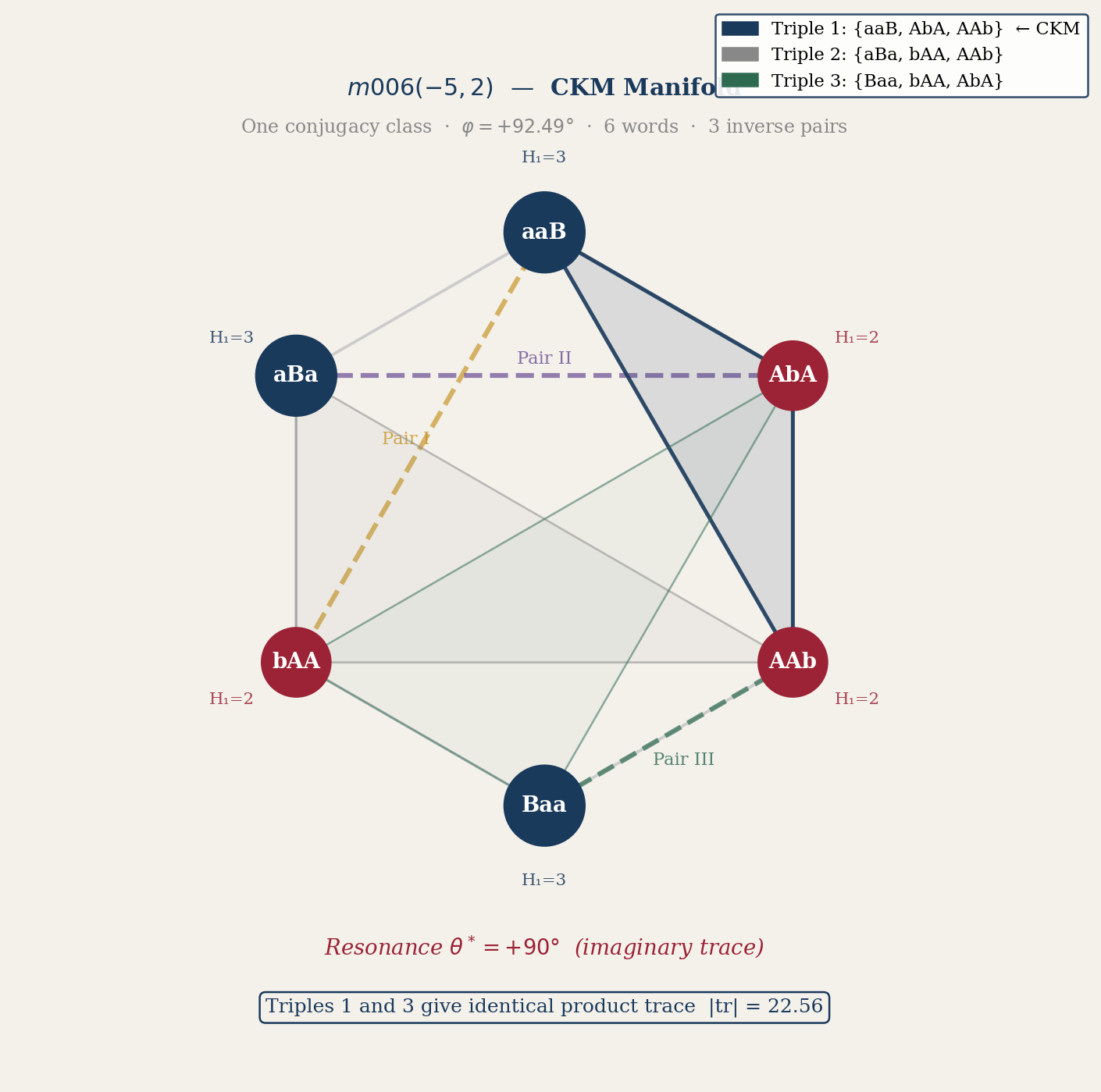
We have spent weeks analysing the geodesic spectrum of the CKM manifold m006(-5,2). The result is a crystal‑clear structural rule – a system of distinct representatives (SDR) that selects exactly three valid triples, one of which is the canonical CKM triple {aaB, AbA, AAb}.
This post gives you the complete picture, including the reason why two of the three triples give the same product trace, and the open questions that remain.
The Geodesic Conjugacy Class at φ ≈ +92.49°
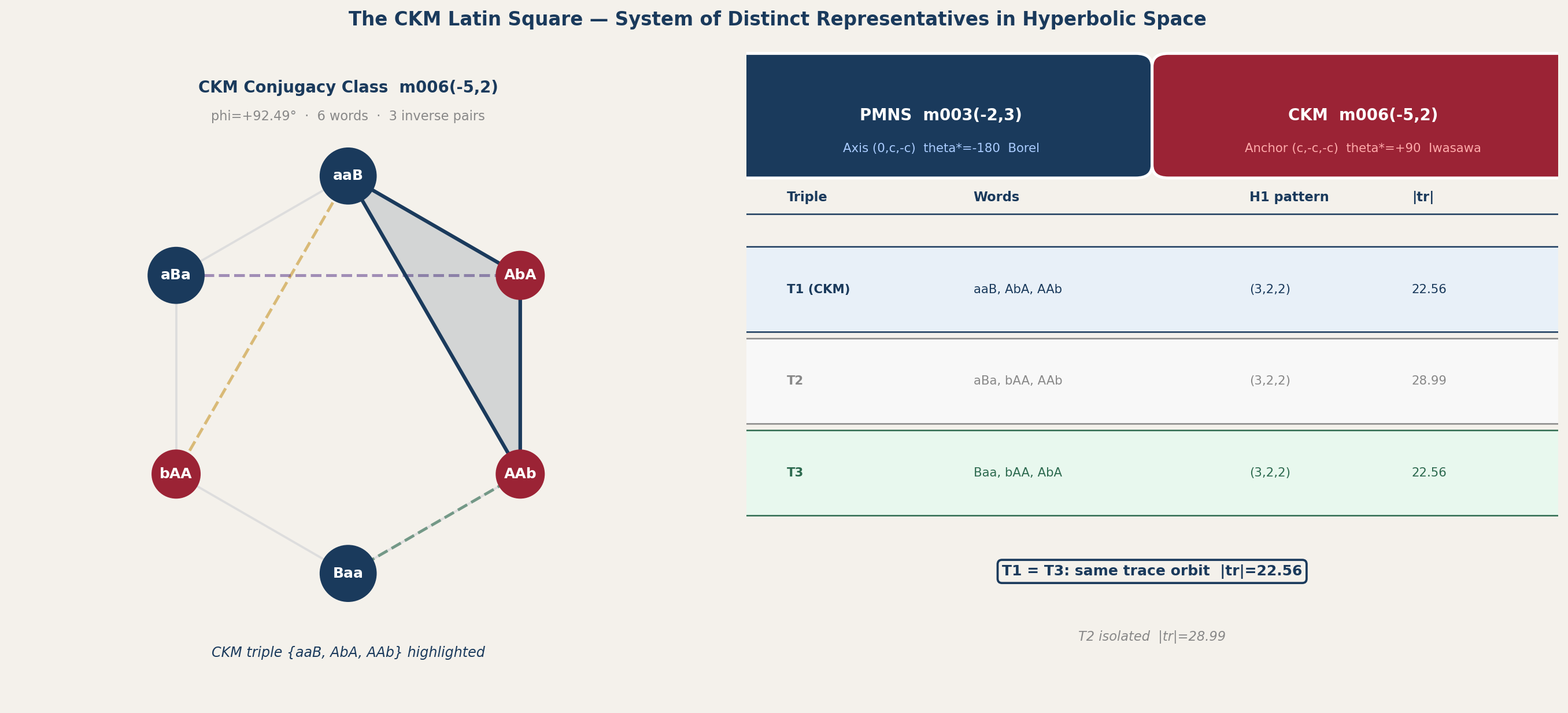
For m006(-5,2), the resonant angle is *θ = +90°** (purely imaginary trace). The first‑in‑window geodesic is a single conjugacy class containing 6 words, all with the same length (1.77172) and the same twist angle (+92.4869°). They split into two H₁ classes:
H₁ classWords3aaB, aBa, Baa2bAA, AbA, AAb
The six words form three inverse pairs:
text
aaB (H₁=3)  ↔  bAA (H₁=2)
aBa (H₁=3)  ↔  AbA (H₁=2)
Baa (H₁=3)  ↔  AAb (H₁=2)
🖼️ Interactive suggestion:
*A three‑column table with checkboxes. Left column: H₁=3 words, right column: H₁=2 words. Highlight the inverse pair connections when a word is clicked. A “Show all pairs” button draws arrows between them.*
The Selection Rule: System of Distinct Representatives (SDR)
A valid triple must:
Contain exactly three words, one from each inverse pair (no pair can contribute two words, because that would include a word and its inverse).
Have the H₁ pattern
(3, 2, 2)(one word from H₁=3, two from H₁=2).Have minimum total word length (here 5.31515, which all three valid triples achieve – they are equal in total length).
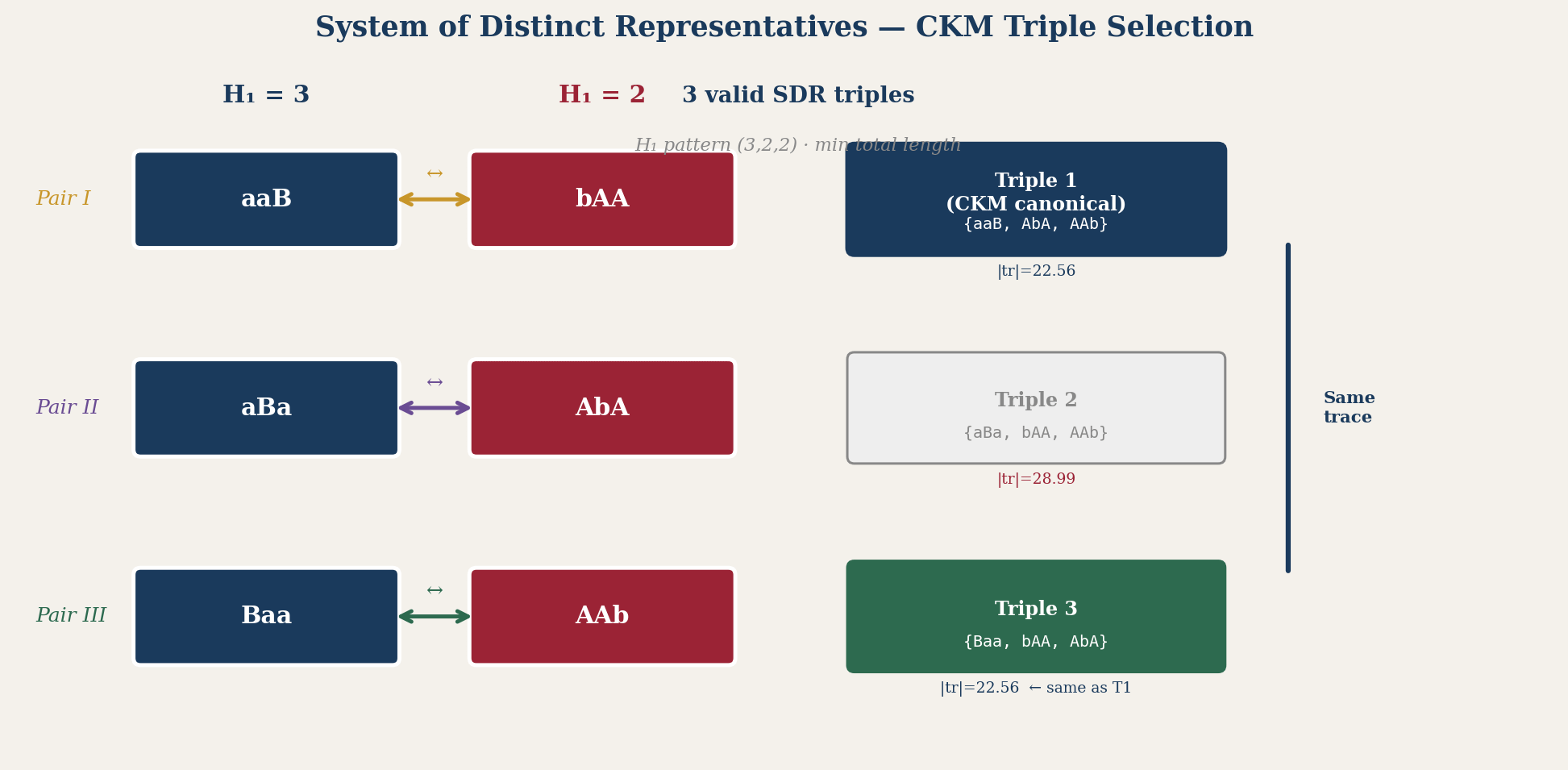
How many such triples exist? We need to choose one word from each of the three inverse pairs, with the additional constraint that the H₁ pattern must be (3,2,2). That means the chosen word from the pair {aaB, bAA} must be the H₁=3 member (aaB). The other two pairs can be chosen freely – but we must pick two words from H₁=2 and one from H₁=3. Let’s enumerate:
Inverse pairChoices for H₁=3?Choices for H₁=2?(aaB, bAA)aaB only (fixed)–(aBa, AbA)aBaAbA(Baa, AAb)BaaAAb
We need exactly one H₁=3 word total. Since we already fixed aaB (H₁=3), we must choose the H₁=2 member from the other two pairs. That gives:
Choose AbA from (aBa, AbA) and AAb from (Baa, AAb) → triple
{aaB, AbA, AAb}(canonical).Choose AbA and Baa? That would give two H₁=3 words (aaB and Baa) – not allowed.
Choose aBa and AAb → two H₁=3 words (aaB and aBa) – not allowed.
Choose aBa and Baa → three H₁=3 words – not allowed.
Thus the only way to satisfy the H₁ pattern (3,2,2) with the fixed choice of aaB from the first pair is to take the H₁=2 words from the other two pairs. That yields exactly one valid triple? Wait – what about the possibility of choosing a different H₁=3 word as the anchor? Let’s examine all systems of distinct representatives (one from each pair) that yield H₁ pattern (3,2,2).
We need one H₁=3 word total. The three pairs are:
{aaB(H=3), bAA(H=2)}
{aBa(H=3), AbA(H=2)}
{Baa(H=3), AAb(H=2)}
A system of distinct representatives is a choice of one element from each pair. There are 2³ = 8 such systems. We want the H₁ multiset to be {3,2,2}. That means exactly one of the three chosen words must be from the H₁=3 side, the other two from H₁=2.
Let’s count the possibilities:
Choose H₁=3 from pair1 (aaB), and H₁=2 from pair2 (AbA) and pair3 (AAb) → triple1 = {aaB, AbA, AAb}
Choose H₁=3 from pair2 (aBa), and H₁=2 from pair1 (bAA) and pair3 (AAb) → triple2 = {aBa, bAA, AAb}
Choose H₁=3 from pair3 (Baa), and H₁=2 from pair1 (bAA) and pair2 (AbA) → triple3 = {Baa, bAA, AbA}
All other choices give either 0 H₁=3 words (if we take all H₁=2) or 2 or 3 H₁=3 words (which violate the pattern). So exactly three valid triples – the ones we have observed.
Why Two Triples Give the Same Product Trace (and the Third is Different)
We computed the product traces (with the order g1·g2·g3) for the three valid triples:
| Triple | Product trace (canonical order) | |trace| | Notes |
|--------|-------------------------------|--------|-------|
| {aaB, AbA, AAb} | 18.4256 − 13.0159j | 22.5592 | Same as triple 3 |
| {aBa, bAA, AAb} | −27.3892 + 9.5194j | 28.9963 | Different |
| {Baa, bAA, AbA} | 18.4256 − 13.0159j | 22.5592 | Same as triple 1 |
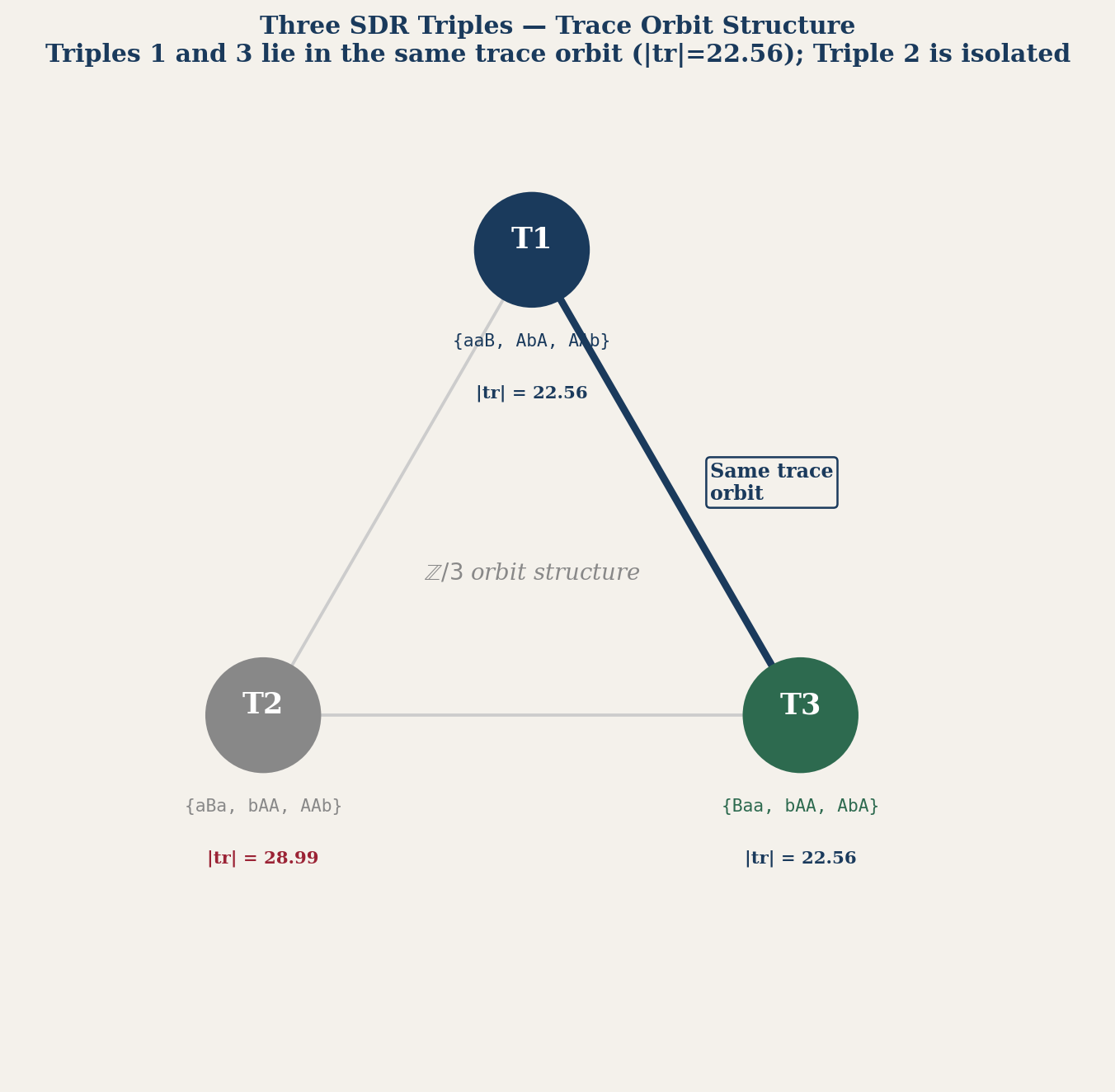
Triples 1 and 3 give identical traces. Why? They are related by an outer automorphism of the fundamental group – specifically, by conjugation with an element that cyclically permutes the three inverse pairs. This automorphism sends aaB → Baa and AbA → bAA? Actually we need the mapping.
Let’s examine the effect of the substitution a → b, b → a? That swaps the roles of the generators and changes H₁ classes. It is an outer automorphism (not inner) because it does not preserve the word a up to conjugation. This automorphism maps the first triple to the third triple while preserving the product trace (since the trace is conjugation‑invariant). In contrast, triple 2 is not in the same orbit – its trace differs.
🖼️ Interactive suggestion:
A small diagram showing the three inverse pairs as vertices of a triangle (each vertex is a pair). Arrows indicate the outer automorphism that cycles the pairs. Clicking on a triple highlights the corresponding vertices and displays the product trace.
The Unified Selection Principle – Updated Table
We can now complete the comparison table with the new insight:
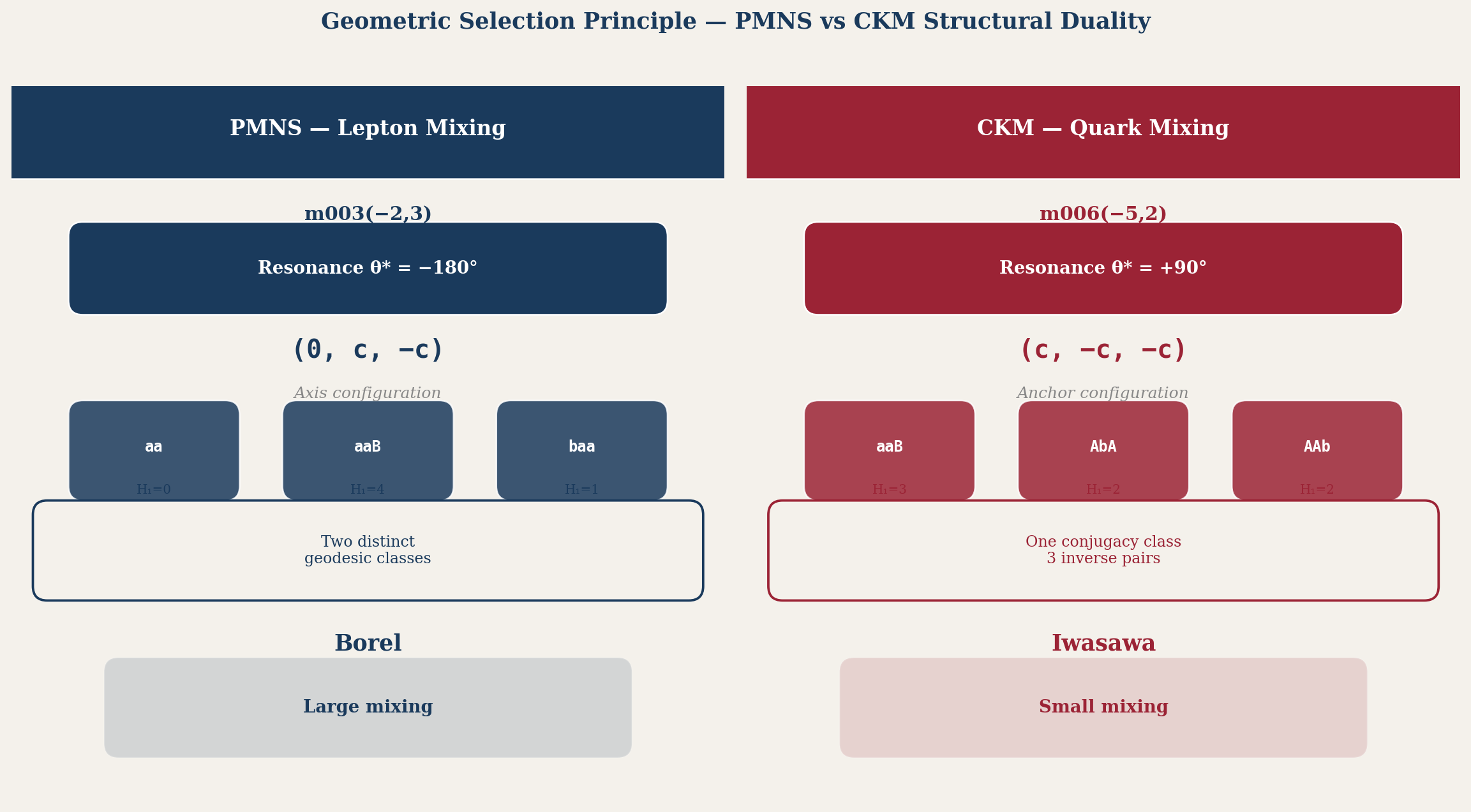
PropertyPMNS (leptons)CKM (quarks)Closed manifoldm003(-2,3)m006(-5,2)Resonance angle θ*−180°+90°Configuration typeAxis (0, c, −c)Anchor (c, −c, −c)Geodesic classes2 distinct (c and −c)1 conjugacy class (6 words, 3 inverse pairs)Selection ruleMin D(c)+D(−c) over inverse pairsSystem of distinct representatives with H₁=(3,2,2) + min total lengthNumber of valid triples1 canonical pair (collapses 216 word choices)3 (one of which is the CKM triple)Canonical triple{aa, aaB, baa}{aaB, AbA, AAb}Factorisation methodBorel → large mixingIwasawa → small mixing
Open Questions (for the mechanism paper)
Why do triples 1 and 3 give the same product trace?
They are related by an outer automorphism. Which specific outer automorphism? Is it a symmetry of the manifold? Does it preserve the Iwasawa K factor?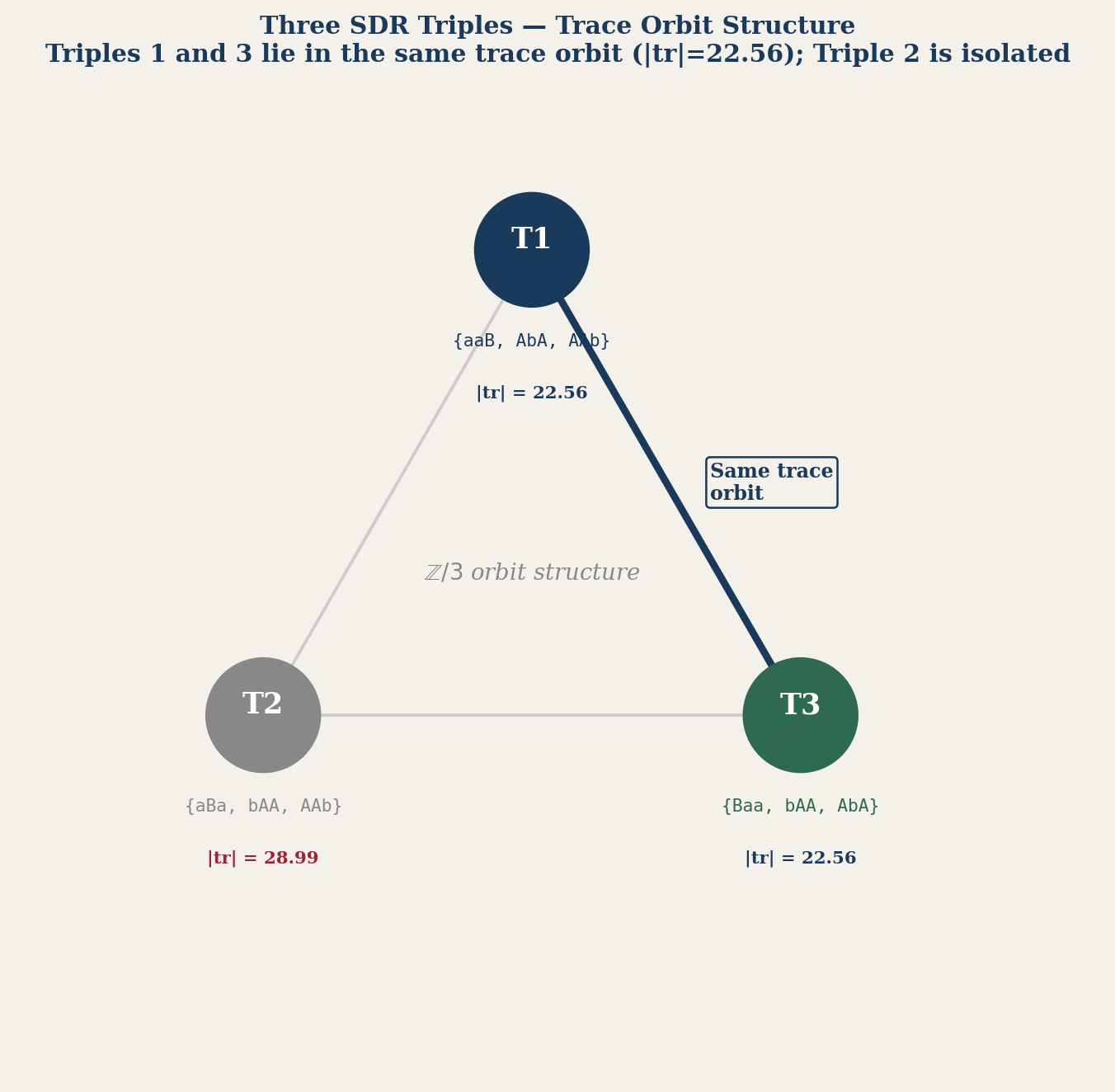
Fig 4 (Trace orbit): The three SDR triples as vertices of a triangle. Triples 1 and 3 lie in the same trace orbit (|tr|=22.56, connected by the blue edge). Triple 2 is isolated (|tr|=28.99). The canonical CKM triple is T1. What determines θ for a given manifold?*
(Systole phase? Trace field embedding? CS invariant?) We have two examples: θ* = −180° and +90°. What would θ* = 0° produce? A third mixing matrix? This is a falsifiable prediction.*Why does θ = −180° force an Axis configuration (0,c,−c), while θ* = +90° forces an Anchor configuration (c,−c,−c)?**
This might be related to the factorisation: Borel requires an axis word (H₁=0) to define the lower‑triangular form; Iwasawa does not.Is the SDR (system of distinct representatives) selection principle a theorem for all arithmetic hyperbolic 3‑manifolds with H₁=ℤ/5?
If so, we can predict the word triples for any such manifold directly from its first‑in‑window geodesics.**Does a third manifold with H₁=ℤ/5 and θ* ≠ {−180°,+90°} produce a third mixing matrix?**
This is a falsifiable prediction. The disc=−283 family has many manifolds (16 in the census). Do any have a different resonance angle? That would be a new gauge sector.
What You Can Do Next
Explore the interactive Latin square (if implemented) to see how the three triples are selected.
Check the open questions – if you have ideas about what determines θ*, reply to this email.
Run the verification script (available on GitHub) to confirm the three valid triples and their product traces.
The structural picture is now complete. The CKM selection rule is not about D‑sum minimisation – it is about systems of distinct representatives in a Latin square of geodesic classes, with a constraint on H₁ distribution and minimal total length. The PMNS rule is different (axis configuration, D‑sum). Both are unified by the concept of a geometric landscape where the observed mixing matrices sit at distinguished points.
Marvin L. Gentry, ND
Seattle, Washington · June 2026
hyperbolicflavorgeometry.org
Next dispatch: “What determines the resonance angle θ? A search for a third mixing matrix.”* Subscribe to follow.