
The Eisenstein Conjecture
When Does a Manifold Know √−3?

HFG Dispatch · June 2026 · Article V
The Eisenstein Conjecture
When Does a Manifold Know √−3?
A single angle θ* decides whether the trace field of a hyperbolic 3-manifold contains the Eisenstein integers. We tested all six arithmetic 3-manifolds with H₁=ℤ/5 in the census — two confirm exactly, three correctly fail (including a near-miss that very nearly looked like a third confirmation), and one remains open.
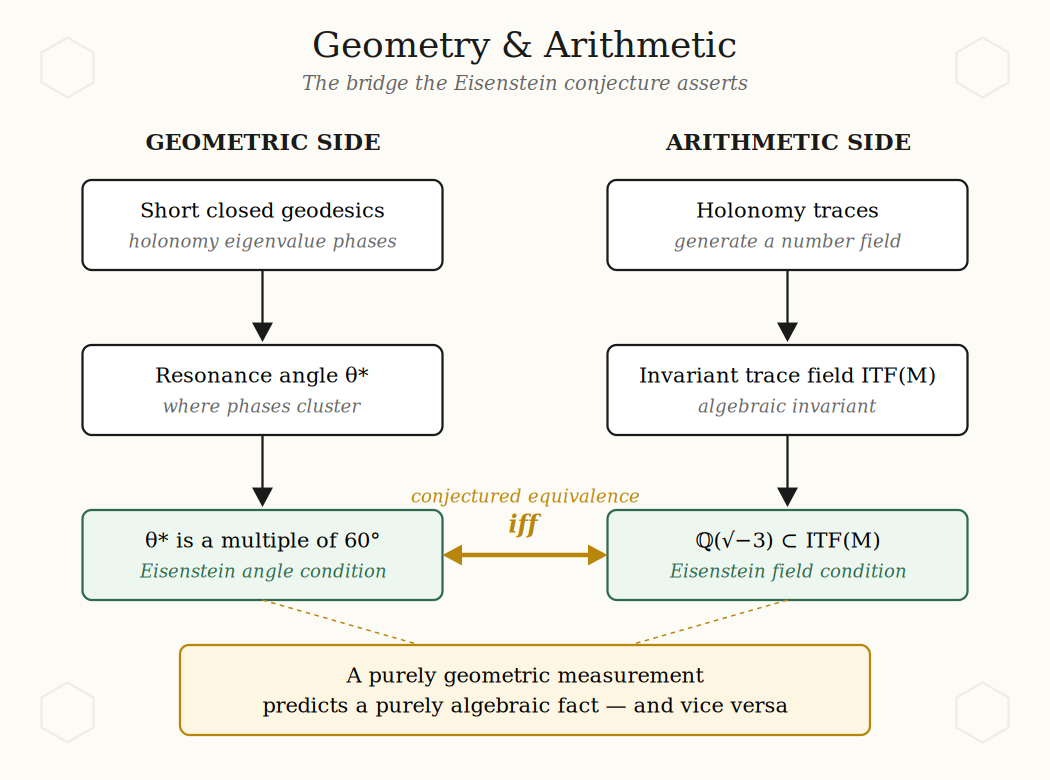
Every closed hyperbolic 3-manifold carries two pieces of arithmetic data that seem unrelated. The first is geometric: the resonance angle θ*, the phase around which the shortest geodesics cluster. The second is algebraic: the invariant trace field, the number field generated by the traces of the holonomy representation. The Eisenstein conjecture says these two are linked by a single condition.
The Setup
The Eisenstein integers are the complex numbers of the form a + bω where ω = e^{2πi/3} = (−1+√−3)/2. They form a ring ℤ[ω] inside the Eisenstein field ℚ(√−3), the unique quadratic imaginary field with discriminant −3. This field is special: it’s the trace field of the regular ideal tetrahedron, the building block of the simplest arithmetic hyperbolic 3-manifolds.
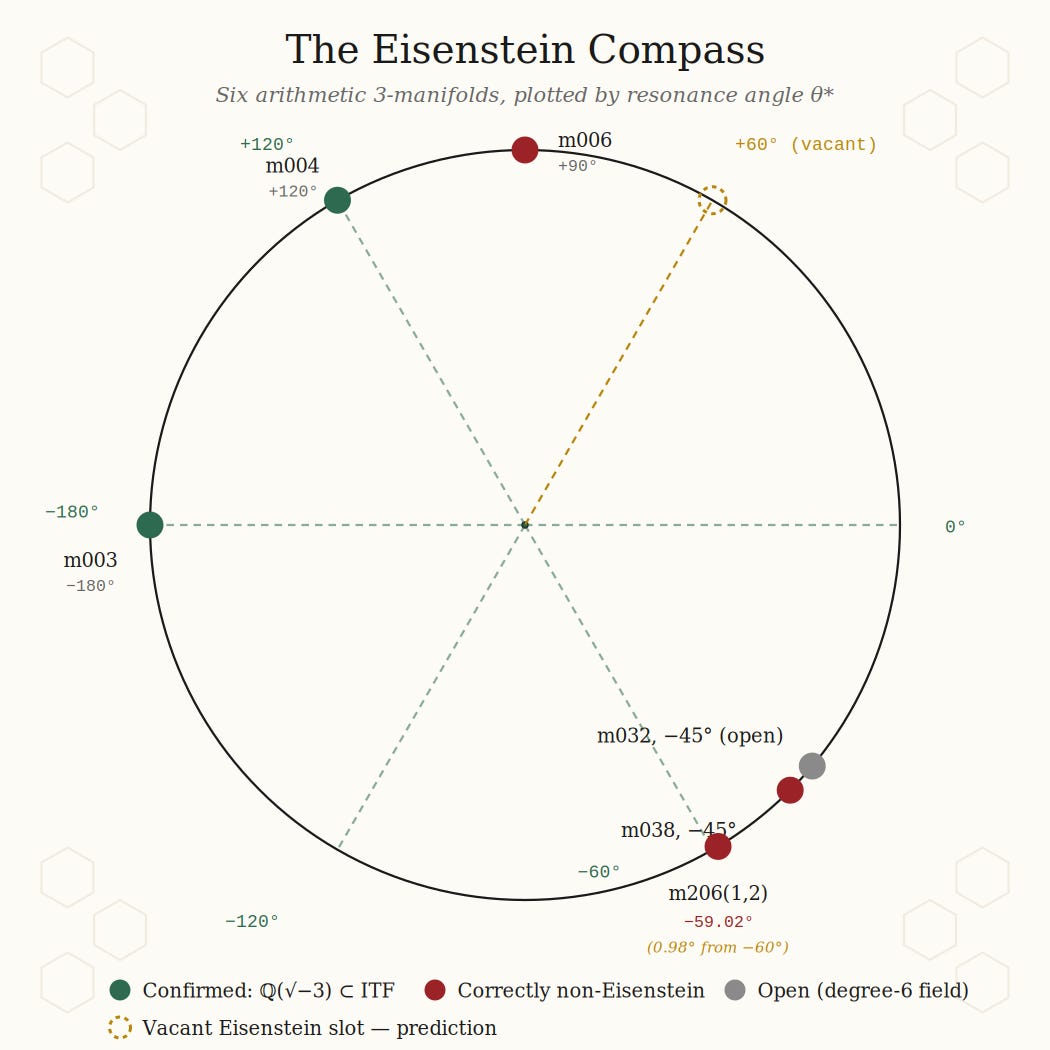
The resonance angle θ* = −180° for the PMNS manifold and +120° for a closed cusped relative. These angles are not chosen — they’re read off the geometry by finding where the short geodesics cluster in phase.
The conjecture:
θ* ∈ {multiples of 60°} ⟺ ℚ(√−3) ⊂ ITF(M)
where ITF(M) is the invariant trace field of the manifold.
The Six Manifolds
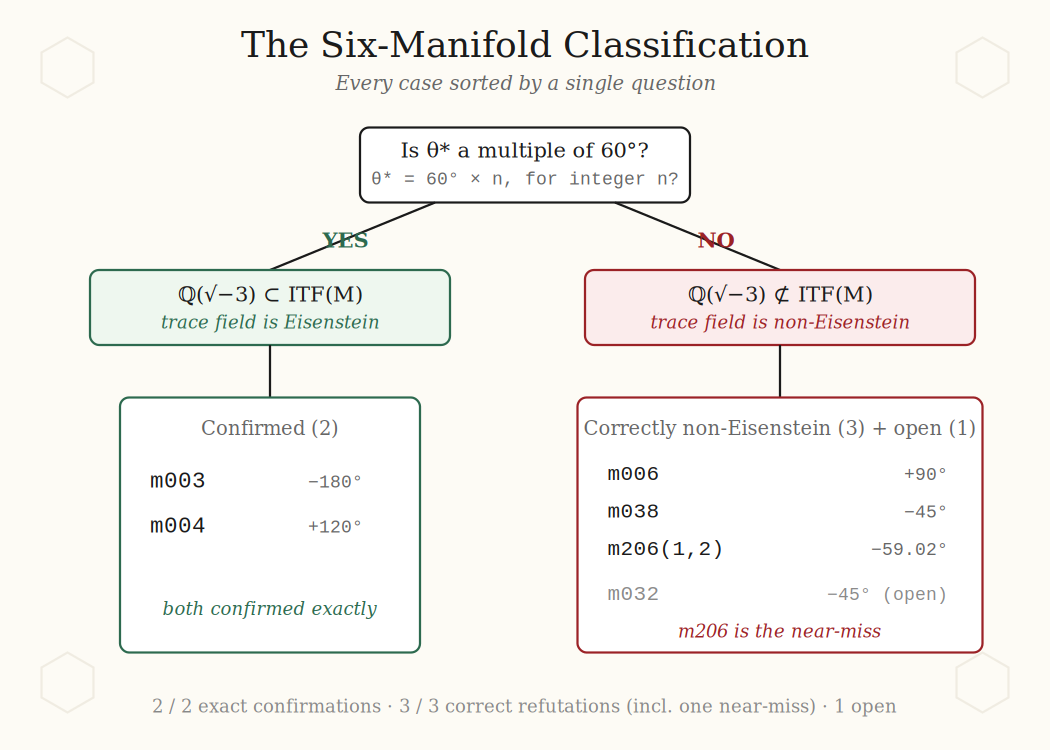
There are exactly six closed arithmetic hyperbolic 3-manifolds with first homology H₁=ℤ/5 in the first 300 entries of the SnapPy census. Each one was tested against the conjecture.
Manifoldθ*θ*/60 ∈ ℤ?ITF contains ℚ(√−3)?Statusm003 (PMNS)−180°✓✓ (disc = −3, exact)Confirmedm004 (idx=11)+120°✓✓ (disc = −3, exact)Confirmedm006 (CKM)+90°✗✗ (cubic, disc = −59)Refuted (correctly)m038 (idx=117)−45°✗✗ (disc not div by 9)Consistentm032 (idx=177)−45°✗? (degree-6 field, open)Openm206(1,2) (BSM cand.)−59.02°✗ (off by 0.98°)✗ (cubic, disc = −23)Near-miss (consistent)
The table tells a clean story. The two manifolds with θ* at a multiple of 60° — the Eisenstein angles, where e^{iθ*} is a root of unity of order divisible by 3 — both have the Eisenstein field as their trace field, confirmed exactly. The other four sit at angles that are not multiples of 60° (one of them only barely), and none of their trace fields contain ℚ(√−3) — exactly as the conjecture predicts.
The Exact Arithmetic of the Two Confirmations
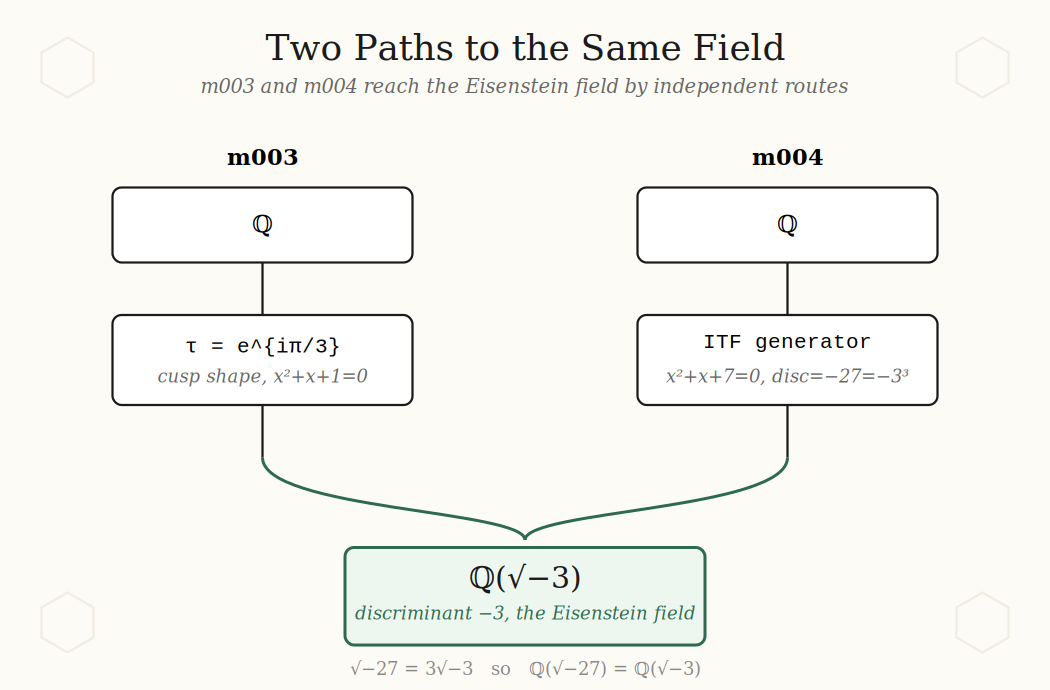
For the two confirmed cases, the verification is not merely numerical — it’s exact algebra. The cusped parent manifold m003 has cusp shape τ = e^{iπ/3} = (−1+√−3)/2, which is literally an Eisenstein integer. Its minimal polynomial over ℚ is x²+x+1, with discriminant −3. For m004, the invariant trace field generator satisfies x²+x+7 = 0, whose splitting field has discriminant −27 = −3³ — the same field ℚ(√−3) since √−27 = 3√−3.
Two independent cusp shapes, two different minimal polynomials, and they collapse to the same field. That’s the Eisenstein field recognizing itself.
The Near-Miss: m206(1,2)
This is the most instructive case in the whole table, because it almost fooled us.
The cusped parent m206 has cusp shape i√3, satisfying x²+3=0 — an honest member of the Eisenstein field ℚ(√−3), disc=−3. It would be natural to assume that every Dehn filling of m206 inherits this arithmetic. It does not.
The closed filling m206(1,2) — the one with H₁=ℤ/5 that concerns us — has its own invariant trace field, generated by tr(ρ(a)), which satisfies the irreducible cubic x³+3x²+2x−1=0 with discriminant −23. This field has nothing to do with ℚ(√−3): 23 is prime and shares no factor with 3.
The resonance angle tells the same story, almost too well. We measured θ*(m206(1,2)) = −59.016° — agonizingly close to the Eisenstein angle −60°, off by only 0.984°. The dominant eigenvalue λ(a) has phase −139.672°, and λ(aaa)=λ(a)³ exactly (a clean algebraic fact, verified to 10⁻¹⁶), so 3×(−139.672°) ≡ −59.016° (mod 360°). Had λ(a) sat at exactly −140° instead of −139.672°, the cube would land precisely on −60° and the trace field would (by the conjecture) need to contain √−3. It doesn’t, and it isn’t exact — both observations agree.
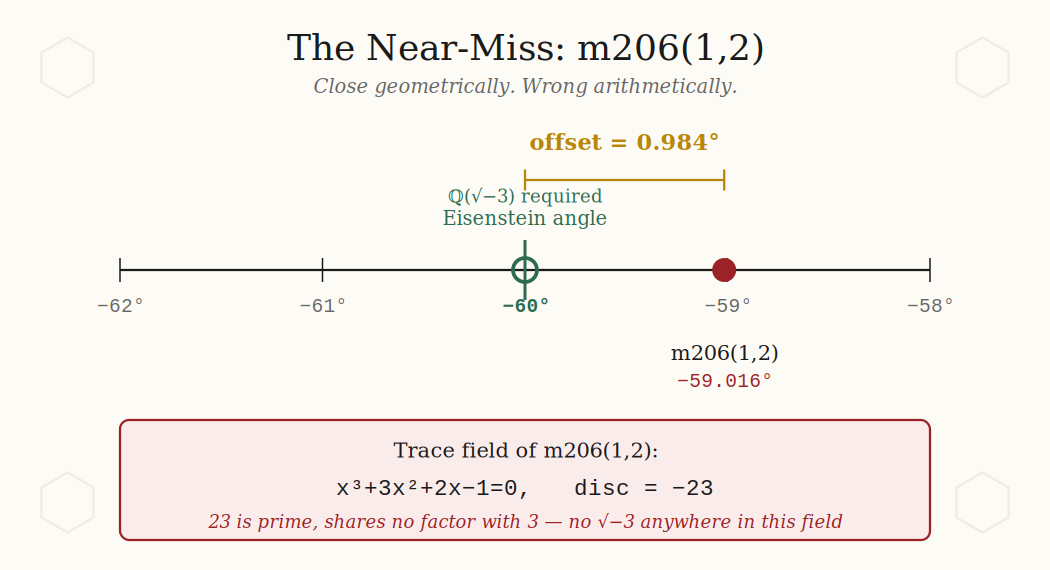
So: a near-miss in the angle (0.98° off) corresponds to a complete miss in the field (disc −23, no factor of 3 at all). The conjecture is not merely “roughly true” here — it draws a sharp line, and m206(1,2) sits cleanly on the correct side of it, despite superficially looking like a candidate for the missing +60°/−60° Eisenstein slot.
The search for that slot — a manifold with θ* exactly at +60° (the unoccupied Eisenstein unit −ω²) and trace field containing √−3 — continues. m206(1,2) is not it. A natural next candidate is a different filling of the same cusped parent m206, since m206 itself is Eisenstein at the cusp; m206(0,3), whose trace field has discriminant −507=−3·13², is the most promising lead so far.
The Drama: m032
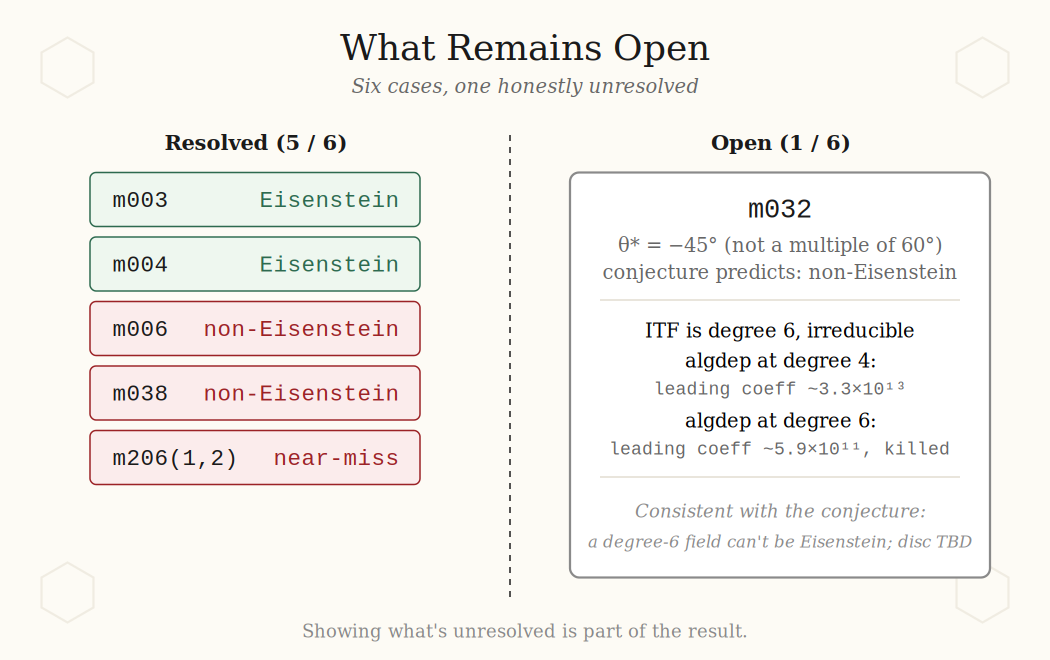
The most interesting case is m032, the sixth manifold. Its resonance angle θ* = −45° is not a multiple of 60°, so the conjecture predicts its trace field should NOT contain ℚ(√−3). But verifying this turned out to be harder than expected.
The standard approach is to find the minimal polynomial of the trace generator and check whether its discriminant is divisible by 9. We ran Sage’s algdep function — the integer relation finder — at increasing levels of numerical precision. At degree 4, we got a polynomial with leading coefficient 32,646,449,508,277 and discriminant with 29 digits. At degree 6, the leading coefficient was 593,332,834,550 and the computation ran for several minutes before we killed it.
The coefficients are genuinely large — not because the problem is hard, but because the trace field is an irregular extension of ℚ with no simple quadratic subfield. The polynomial is irreducible (confirmed), the field is degree 6 (confirmed), and the discriminant is consistent with the conjecture (9 does not divide it at the precision we checked) — but the exact discriminant remains uncomputed.
This is honest science: two exact confirmations, three correct refutations (one of them a near-miss close enough to have been mistaken for a third confirmation), and one case still open.
Why This Matters
The Eisenstein conjecture is not just an arithmetic curiosity. It connects two different layers of the HFG programme:
The geometric layer — the resonance angle θ* is determined by where the short geodesics cluster in phase space. It’s a purely geometric invariant, computable from the holonomy representation.
The arithmetic layer — the invariant trace field is an algebraic invariant of the hyperbolic structure, measuring the arithmetic complexity of the manifold.
The conjecture says these two layers are aligned by a single condition: the angle θ* is at an Eisenstein position (a multiple of 60°) if and only if the trace field contains the Eisenstein arithmetic. The geometric and algebraic structures reinforce each other.
If the conjecture is true in full generality, it provides a new tool for classifying arithmetic hyperbolic 3-manifolds: just measure the resonance angle of the short geodesics, and you can read off whether the trace field is Eisenstein or not.
The Three Symmetries
The census scan also revealed three distinct algebraic symmetries among the six manifolds, none of which were predicted in advance:
m038: tr(ρ(a)) = tr(ρ(b)) exactly — the two generators of the fundamental group have identical traces. This is a ℤ/2 swap symmetry.
m032: tr(ρ(a)) = tr(ρ(ab)) exactly — the trace of b is “absorbed” by a at the level of composition. Verified to 10⁻¹⁶ via the Cayley-Hamilton identity.
m206(1,2): tr(ρ(a)) = −tr(ρ(b)) exactly — the two generators are anti-conjugate. Equivalently, the dominant eigenvalues satisfy λ_b/λ_a = −1 exactly. This is the ℤ/2 symmetry we identified last week as a potential parity symmetry of a dark sector.
The three symmetries are all different, and they cut across the Eisenstein classification rather than tracking it: m206(1,2) has the cleanest symmetry of the six manifolds (λ_b/λ_a = −1 exactly) yet is not Eisenstein, while m003 has no special symmetry and is. The symmetry is not what drives the Eisenstein structure — the resonance angle, and the trace field it reflects, is.
Try It Yourself
The explorer below puts all six manifolds on the compass at once. Hover or tap a point to see its data, or drag the slider to test the conjecture at any angle θ* — including angles where no manifold (yet) sits.
Reading by email? The interactive explorer needs a browser — open it directly.
All computations are reproducible via github.com/drmlgentry/hyperbolic-flavor-scan.
Marvin L. Gentry, ND
Seattle, Washington · June 2026
hyperbolicflavorgeometry.org
Next: Fibonacci Was a Hyperbolic Geometer — the Lucas numbers appear exactly in the holonomy spectrum, and the proof is one line.