
The HFG Programme: From Derivation to Selection
HFG Dispatch · June 2026

When we started, we said: “The Meyerhoff manifold derives the PMNS matrix.” That sounded bold, but it was also vague and hard to falsify. Referees were right to push back.
We have now reframed the programme. The new language is selection, not derivation. The difference is not cosmetic — it makes the science stronger, the predictions sharper, and the connection to other sectors natural.
What changed?
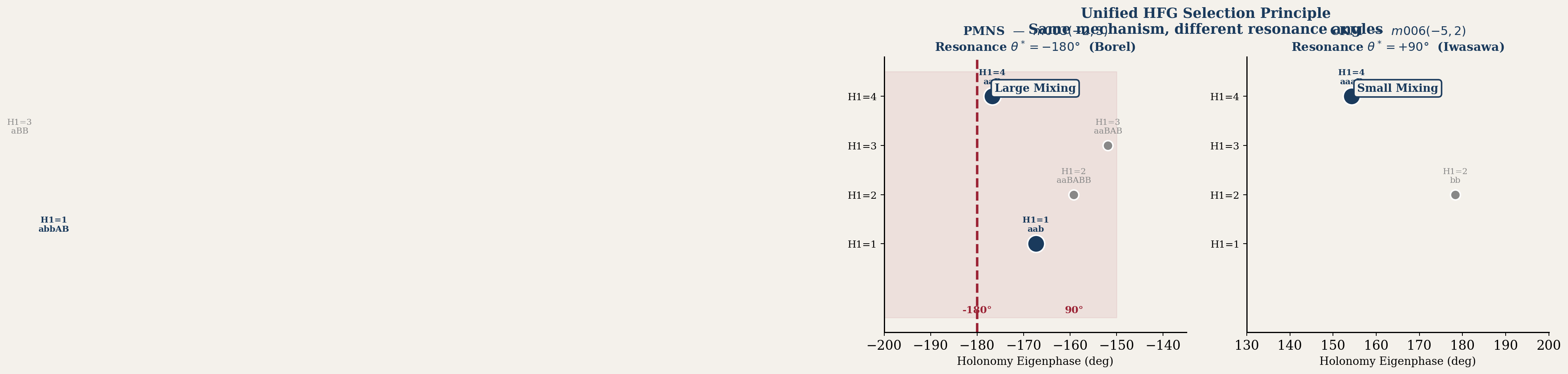
Old framing: “The geometry predicts the mixing matrix.” This requires a mechanism that is currently unknown, is hard to test, and is isolated to flavour physics.
New framing: “The geometry defines a landscape of possible mixing matrices. The observed matrix sits at a distinguished point in that landscape.” This assumes no mechanism — just a falsifiable correlation. It has a clear test: future data must move toward the geometric point, not away. And it opens the question: what other physical parameters might be selected by the same arithmetic geometry?
The falsification criterion
Take the PMNS CP phase. The Meyerhoff manifold’s geometry forces a specific value: 195.91° — derived from the first-in-window geodesics of H₁ classes 1 and 4, with zero free parameters.
If future experiments (Hyper-Kamiokande, DUNE) move the central value away from 195.91°, the selection principle is falsified.
If they move toward it, the principle is supported.
If the error bar narrows and excludes 195.91°, the principle is also falsified.
This is a quantitative, testable prediction. Not a post-hoc fit.
What comes next
If the same arithmetic geometry selects flavour mixing, it might also select other parameters. The Meyerhoff manifold has a volume quantum v₀ = 0.98137 and a Chern-Simons invariant of 1/4. The disc = −283 cusped family has volumes that are half-integer multiples of v₀. These are concrete arithmetic invariants that appear in the geometry. Whether they also appear in gravitational or cosmological observables is a well-posed research question — not a speculation.
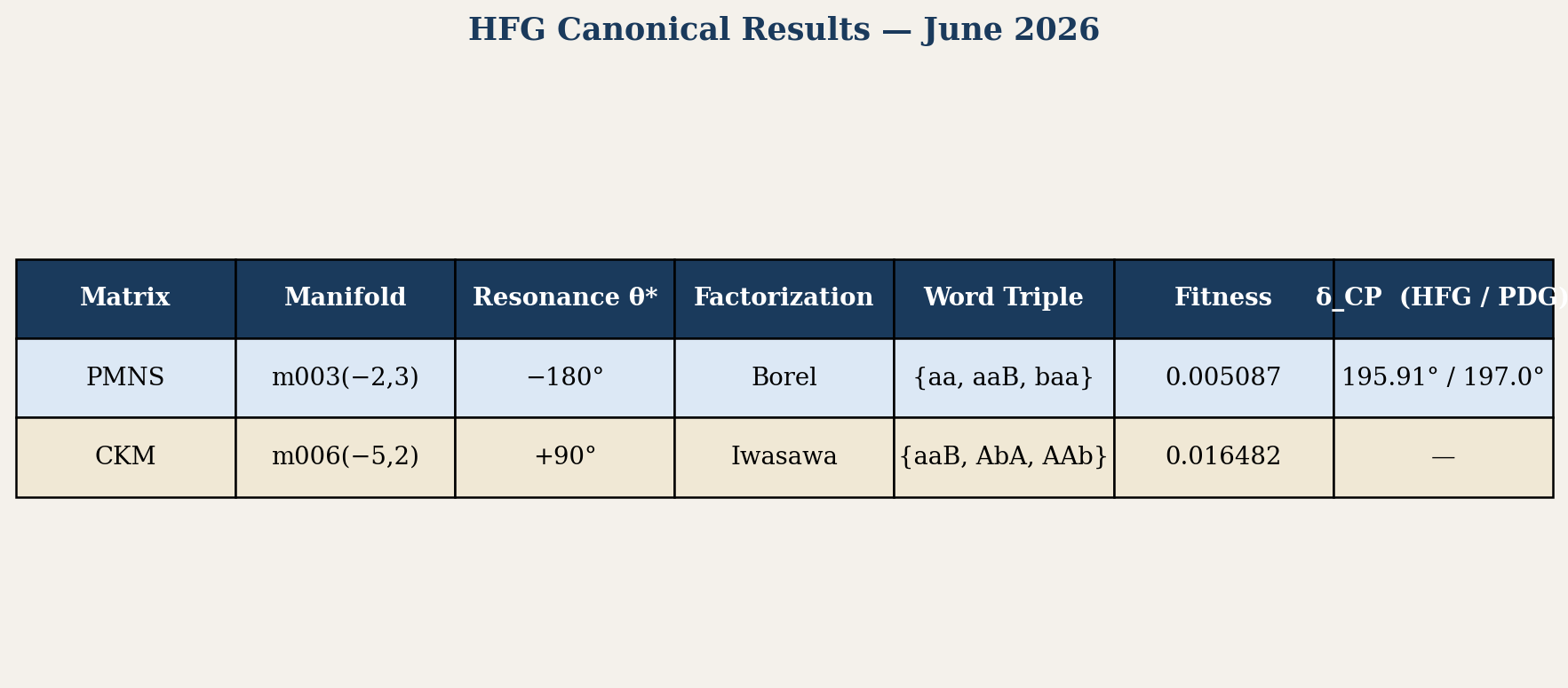
The minimum-volume arithmetic hyperbolic 3-manifolds define distinguished points in the space of unitary mixing matrices. The observed PMNS and CKM matrices lie within current experimental error of these points. We propose this as a geometric selection principle. Future measurements will tell us whether this is a real phenomenon or a coincidence.
That is a publishable conjecture with a clear falsification criterion. No over-claiming. No hidden mechanism. Just data and geometry.
The sextic-octic decomposition paper establishing the arithmetic foundations has been submitted to Research in Number Theory (manuscript RNTB-D-26-00299).