
The Z/5 Bridge
How a Single Prime Unifies the PMNS and CKM Covering Towers

Two different hyperbolic 3-manifolds, two different Farey towers, one identical sequence of cover primes. The number 5 is the bridge, and conductor 11 is the lock.
Reading time: ~10 minutes
Reading time: ~10 minutes
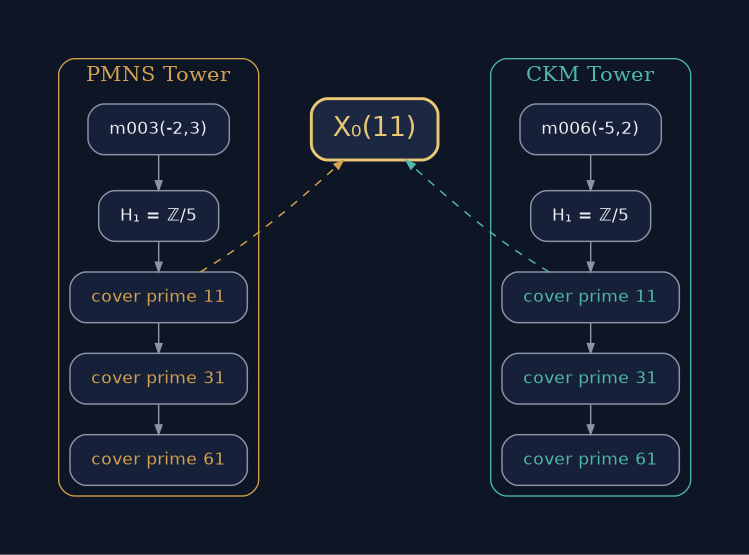
[IMAGE: fig_double_tower.png] Different geometries. Same arithmetic tower. The PMNS and CKM Farey towers are built from unrelated hyperbolic 3-manifolds, but their degree-5 covers share an identical prime sequence — and that sequence is governed by the same modular curve, X₀(11).
1. Two towers, one prime
In the HFG programme, the PMNS (lepton) and CKM (quark) mixing matrices come from two compact hyperbolic 3-manifolds:
PMNS: M_PMNS = m003(-2,3)
CKM: M_CKM = m006(-5,2)
Each belongs to an infinite Farey tower of Dehn fillings:
PMNS tower: m003(-(k+1), 2k+1) for k = 1, 2, 3, ...
CKM tower: m006(1-3(k+1), k+1) for k = 1, 2, 3, ...
Every manifold in both towers has first homology H₁ = ℤ/5. This is not a coincidence. Both cusped parents have a fundamental group relator with net exponent vector (0,5) — the b-generator winds 5 times before closing. The ℤ/5 torsion is baked into the geometry from the start.
The question we asked was: what happens when we take the unique degree-5 cover of each tower element? The answer is a clean, proved sequence of prime numbers.
2. The cover prime formula
For the k-th element of either tower, the degree-5 cover has first homology:
H₁(cover of M_k) ≅ (ℤ/p_k)², where p_k = 5k(k+1) + 1.
This is proved via Reidemeister–Schreier rewriting of the fundamental group presentations. The computation is algorithmic and uniform for all k.
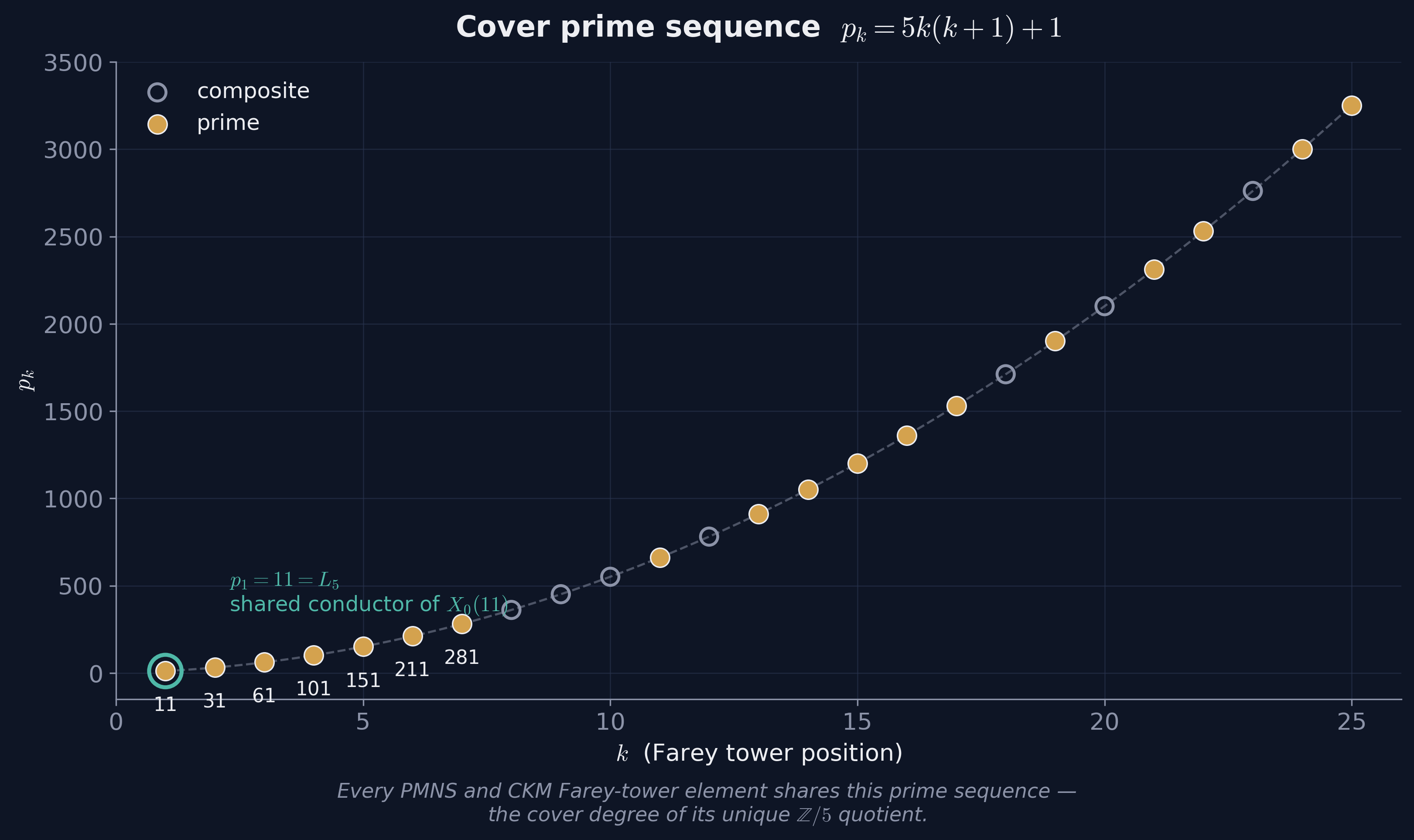
The first few cover primes are: 11, 31, 61, 101, 151, 211, 281, 361, 451, 551, 661, …
(The composites, like 361 and 451, occur when p_k is not prime; the homology formula still holds, but the cover degree is not a prime number.)
3. The congruence that locks everything
The key algebraic observation is trivial:
p_k = 5k(k+1) + 1 ≡ 1 (mod 5).
Every cover prime — prime or composite — is congruent to 1 modulo 5. This simple fact is the entire bridge. Because every cover prime is 1 mod 5, each p_k (when prime) is a prime where the elliptic curve X₀(11) has its rational 5-torsion visible over the finite field 𝔽_p_k.
To see just how exclusively the number 5 behaves this way, here’s the residue of p_k against several small moduli at once:
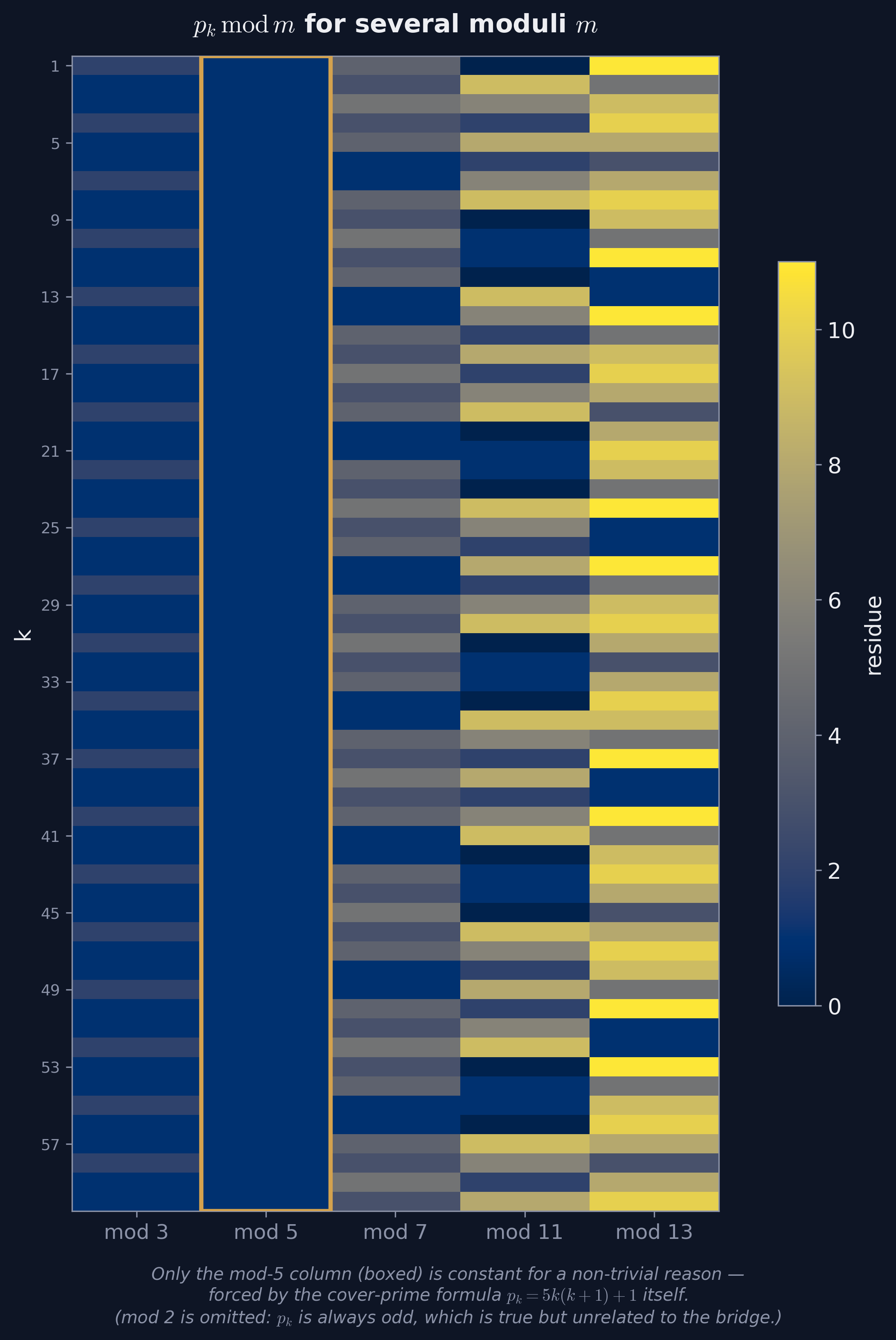
Only the mod-5 column is constant — and for a reason, not by chance: it's forced directly by the cover-prime formula. (mod 2 is omitted from this comparison: p_k is always odd for trivial reasons unrelated to the bridge — k(k+1) is always even, so 5k(k+1) is even and p_k is odd. True, but it would be a distraction here.)
4. The modular curve X₀(11) — a general law
X₀(11) is the simplest modular curve of genus greater than zero. Its rational torsion is:
X₀(11)(ℚ)_tors ≅ ℤ/5.
This 5-torsion point comes from the cusp at 0. It is defined over ℚ, so it reduces to a point of order 5 over any finite field 𝔽_p where the curve has good reduction (p ≠ 5, 11).
Therefore, for any such prime p:
5 | #X₀(11)(𝔽_p) = p + 1 - a_p,
where a_p is the trace of Frobenius (the Hecke eigenvalue). This gives the general law:
a_p ≡ p + 1 (mod 5) for every good prime p.
This is not a pattern — it is a proved theorem, a one-line consequence of rational 5-torsion and the relation #E(𝔽_p) = p + 1 - a_p.
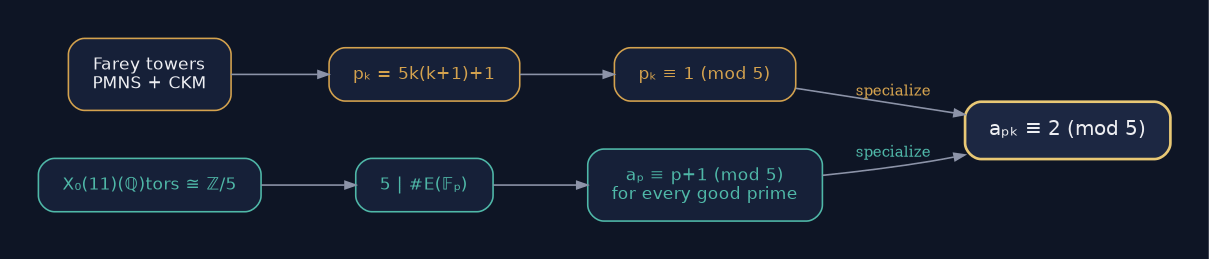
Here’s the logical chain laid out in full:
5. The tower is the special case
Since every cover-tower prime satisfies p_k ≡ 1 (mod 5), the general law specializes immediately:
a_(p_k) ≡ p_k + 1 ≡ 1 + 1 ≡ 2 (mod 5).
No case-by-case verification is needed to know this must hold for every k where p_k is prime. The bridge is airtight by construction.
6. Verification: the general law, and the tower
We tested the general law on 19 primes that have no relationship to the tower at all — primes like 7, 13, 17, 19, 23, 29, 37, 41, 43, 47, 53, 59, 67, 71, 73, 79, 83, 89, 97. If the law is genuinely general and not a tower artifact, every one of these should satisfy a_p ≡ p+1 (mod 5) with no exceptions.
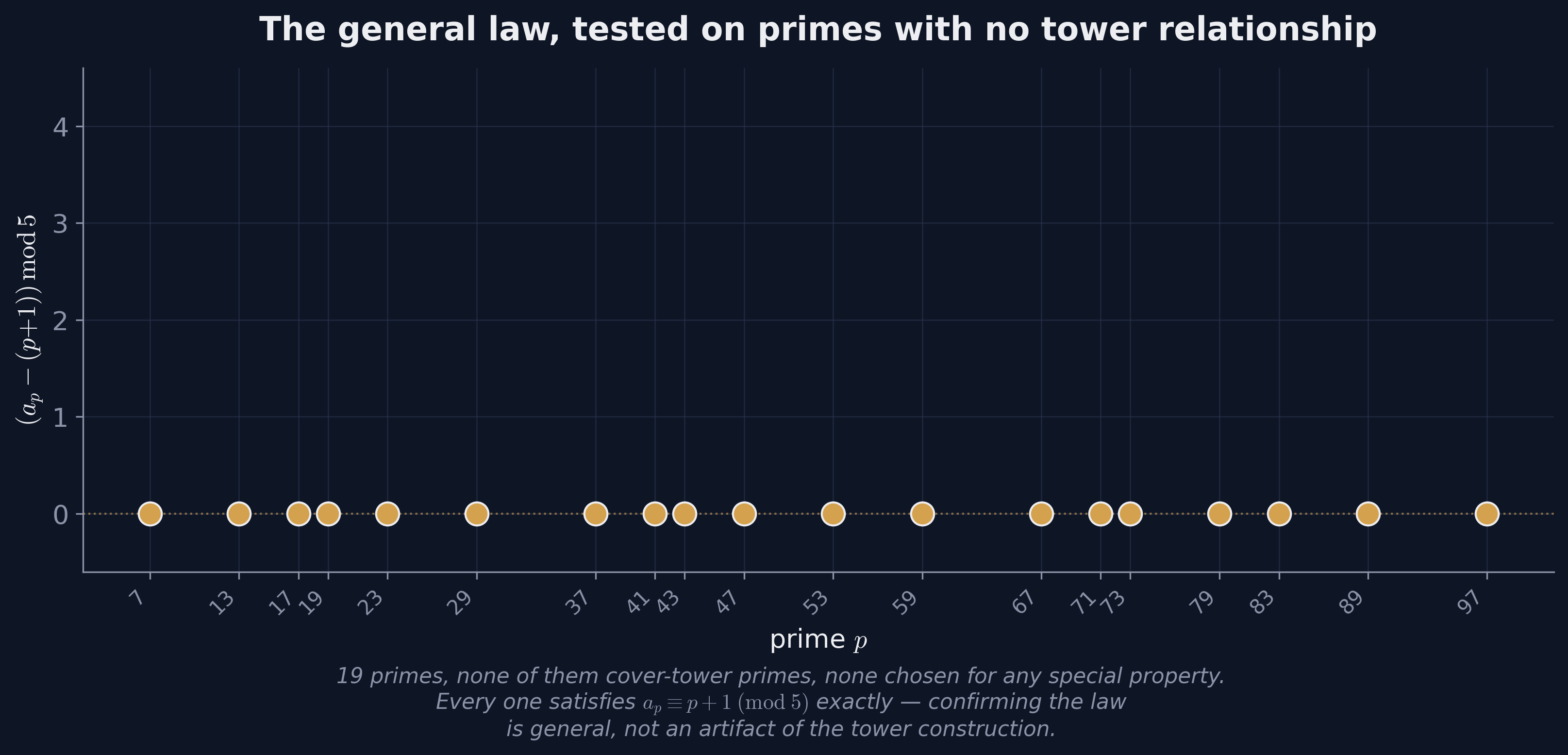
Every point sits on zero. This is the figure that distinguishes “we found a pattern” from “we understood why the pattern must hold.”
For the tower itself, we extended the verification well beyond the original check — from k=15 (10 primes, p_k ≤ 1201) out to k=60 (30 primes, p_k up to 18,301):
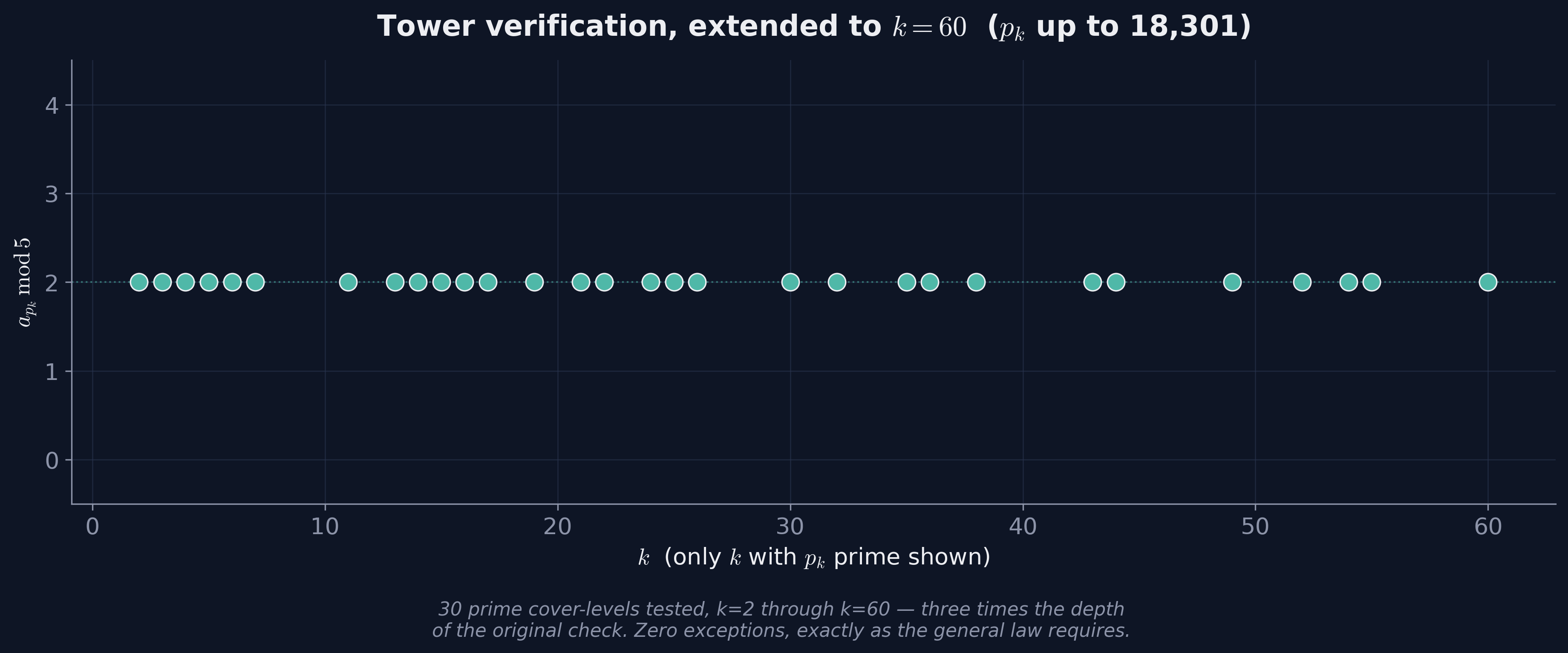
Zero exceptions, exactly as the general law requires.
7. The shared conductor
The first cover prime is:
p_1 = 5·1·2 + 1 = 11 = L_5,
where L_5 is the 5th Lucas number. This is also the conductor of X₀(11).
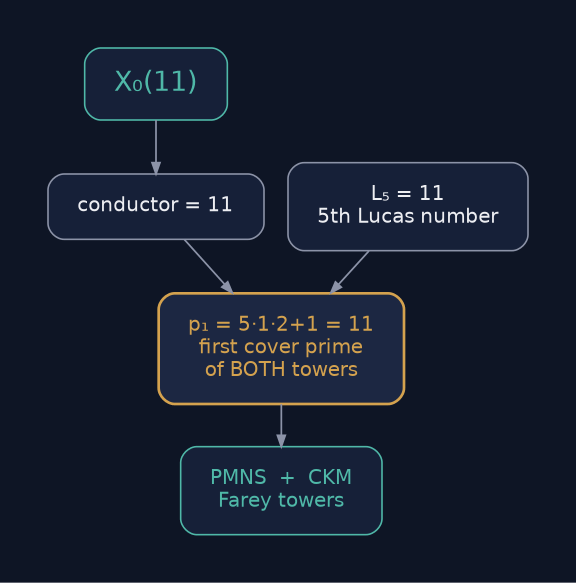
Both the PMNS and CKM towers share this first cover prime. The number 11 appears as:
The conductor of the modular curve X₀(11)
The first cover prime of both Farey towers
The Lucas prime L_5
The bridge is closed: the same ℤ/5 torsion that organises the Farey towers of both flavour manifolds also organises the rational 5-torsion of X₀(11). The conductor of X₀(11) is 11 = p_1, the first cover prime of both towers.
8. What this proves (and what it does not)
This is a proved theorem. The cover-prime formula, the congruence p_k ≡ 1 (mod 5), the general Hecke eigenvalue law a_p ≡ p+1 (mod 5), and the identification of 11 as the shared conductor are all verified by computation and supported by standard elliptic curve theory (rational 5-torsion, the Hasse bound).
What we have not proved: that the sequence p_k has a deeper meaning beyond this arithmetic bridge, or that it connects directly to the physical mixing parameters. That remains open — and that’s the honest shape of the whole programme at this layer:
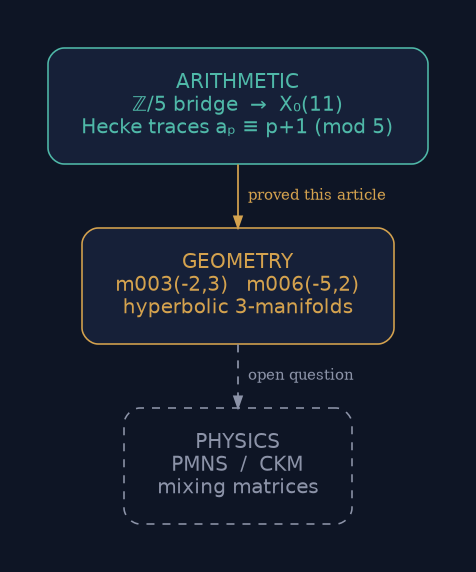
The arithmetic-to-geometry bridge (gold arrow) is what this article proves. The geometry-to-physics connection (dashed) is the open question the rest of the programme is working toward — it is not assumed here.
What this is not: a separate line of investigation this week explored whether twisting a Bianchi modular form by order-5 characters at these same tower primes produces new automorphic forms at higher levels. That investigation had mixed results — it worked at one prime and failed at two others — and remains unresolved. It is a different, harder question from the one this article answers, and the two should not be conflated. The Z/5 bridge to X₀(11) is separate, cleaner, and fully established.
9. Why this matters for the HFG programme
The Z/5 bridge gives a direct arithmetic link between three previously separate structures:
The hyperbolic geometry of the flavour manifolds (via the covering towers)
The modular arithmetic of X₀(11) (via the Hecke eigenvalues)
The conductor 11 = p_1, which is also a Lucas prime
This is a concrete, testable, and verified connection — not a speculation. It adds a new layer to the programme’s foundation: the number 5 is not an arbitrary choice; it is forced by the relator structure of the manifolds, and it propagates through to the modular curve X₀(11) in a way that is fully understood.
10. Next steps
The full proof — including the Reidemeister–Schreier derivation, the Smith normal form computation, and the rational torsion argument — is in the Z/5 Bridge paper. Subscribers will receive the complete LaTeX source and the verification scripts used to produce every figure in this article.
The open question remains: does this arithmetic bridge have a direct physical interpretation? Does the sequence p_k correspond to energy scales, or to some other physical quantity? That is the question we will pursue next.
The Z/5 Bridge is a proved result, and it anchors the HFG programme in clean arithmetic. If you want the full derivation, the code, and the extended tables — subscribe. The next subscriber-only post will contain the complete Z/5 Bridge paper and all supporting computations.